Product data architecture
Organize product attributes, submissions, documents, parties, reviews, and master file references around a persistent product identity.
HEALTH / REGULATORY INTELLIGENCE
PLATOProduct Lifecycle Analytics for Tobacco Oversight connects fragmented regulatory information into a traceable, product-centered reviewer experience.
Prototype accelerator · Public-data foundation · Human review

THE REGULATORY CHALLENGE
Product names, identifiers, and submission events can change over time. PLATO provides a product-first design for connecting original applications, amendments, resubmissions, documents, and decisions.
Bring the supporting passage, proposed relationship, and reviewer decision together so analysts can understand both what changed and why an association was proposed.
SIX CONNECTED CAPABILITIES
Client-specific workflows are proposed for configuration and evaluation using authorized data.
Organize product attributes, submissions, documents, parties, reviews, and master file references around a persistent product identity.
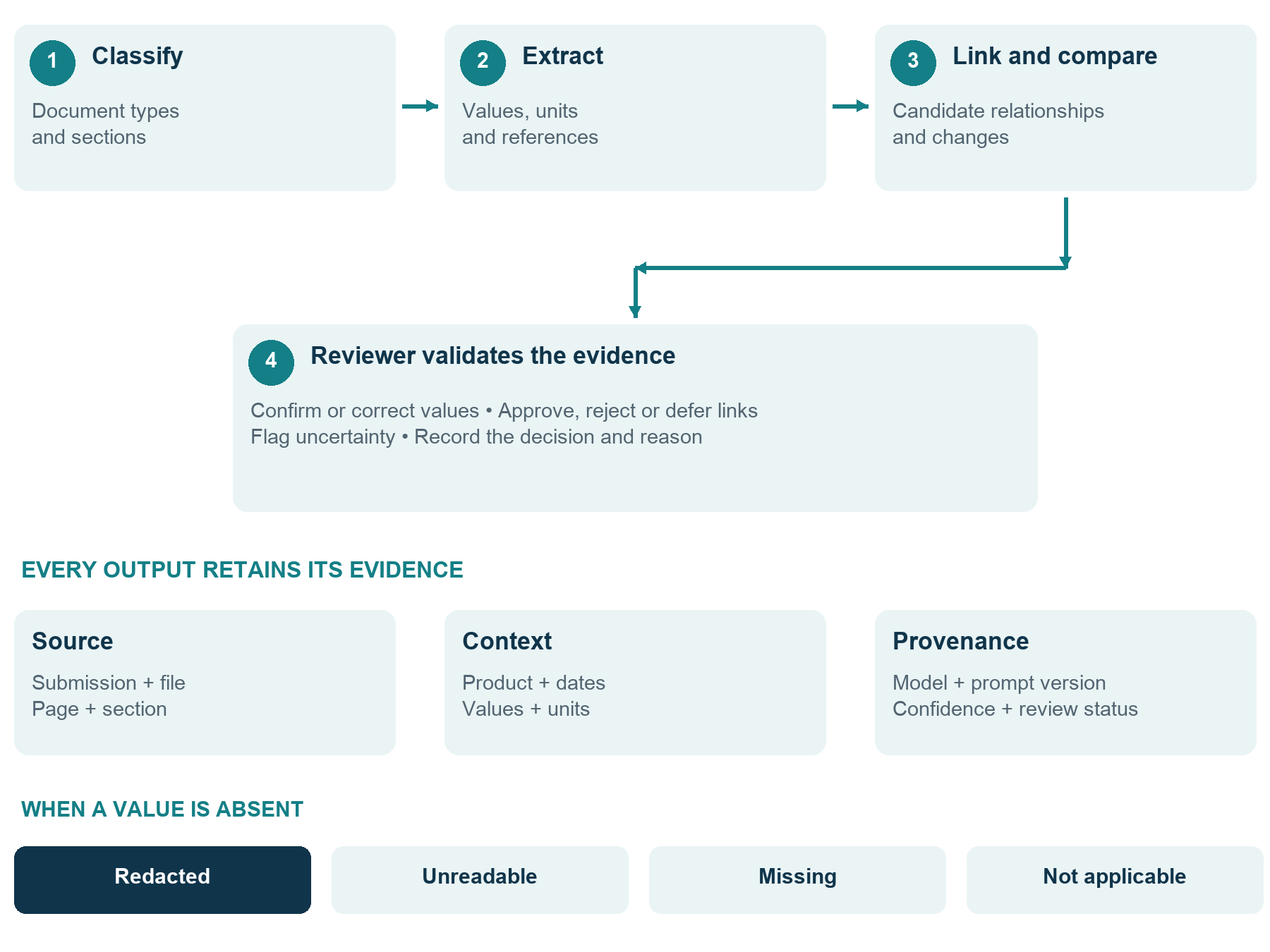
Configure document classification and attribute extraction with values, units, confidence, and source locations.
Use explicit identifiers and documented references first. Present attribute-based associations with rationale for reviewer approval.
Reconstruct product histories and compare versions while distinguishing event, document, and effective dates.
Retain page and section references, OCR and redaction flags, model and prompt versions, and reviewer decisions.
Prepare interface specifications, schemas, versioned configurations, dependencies, and reproducibility guidance.
TOBACCO REGULATIONS & ANALYTICS
PLATO’s proposed information model connects tobacco submission pathways with product histories, source evidence, and human review. These graphics illustrate the design rather than a live application.
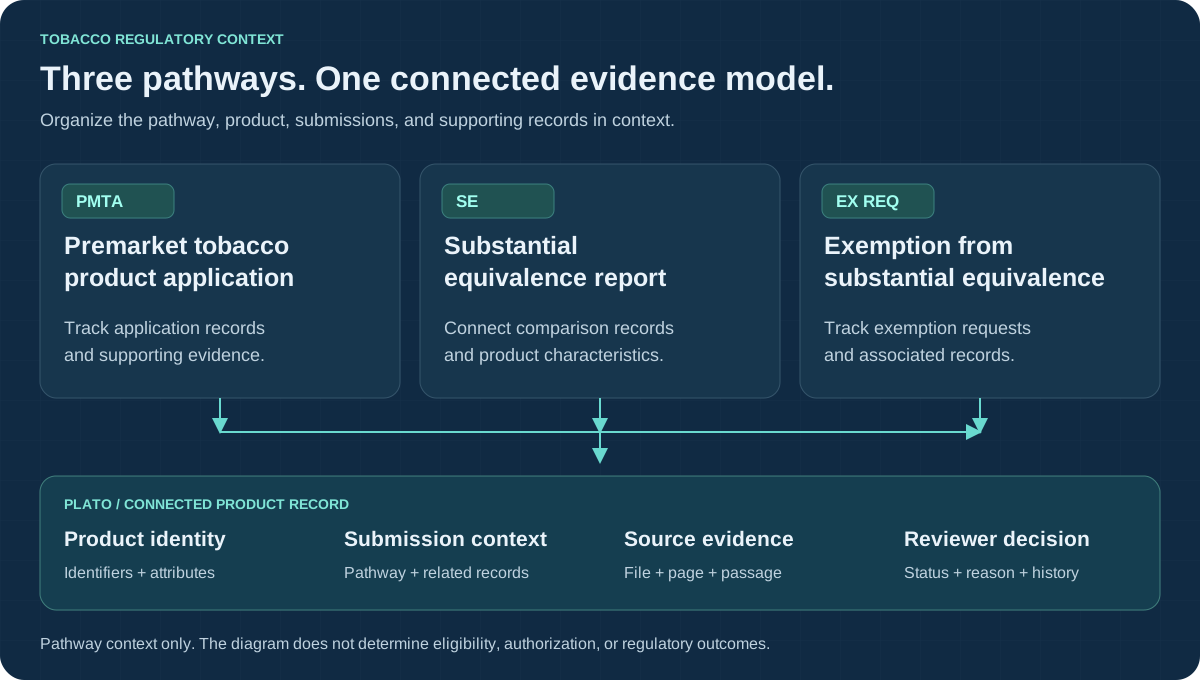
Premarket Tobacco Product Application: organize application records and supporting evidence.
Substantial Equivalence: connect comparison records and product characteristics.
Exemption from Substantial Equivalence: retain request context and associated records.
TOBACCO PRODUCT LIFECYCLES
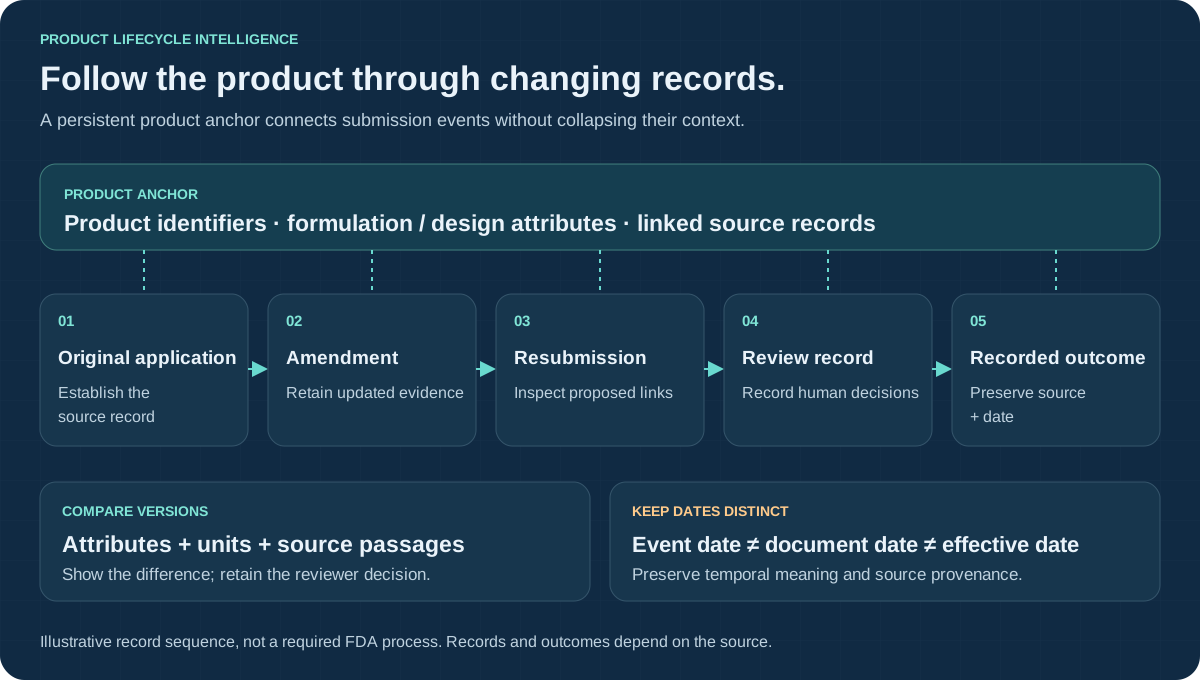
A product anchor gives reviewers continuity as submission identifiers and records change. Compare formulation or design attributes, retain source passages, and keep event, document, and effective dates distinct.
EVIDENCE ANALYTICS
Explore source coverage, version differences, and review workload. Tobacco-specific examples include nicotine concentration and units, ingredient and formulation references, harmful and potentially harmful constituent (HPHC) test-result references, and product design attributes.
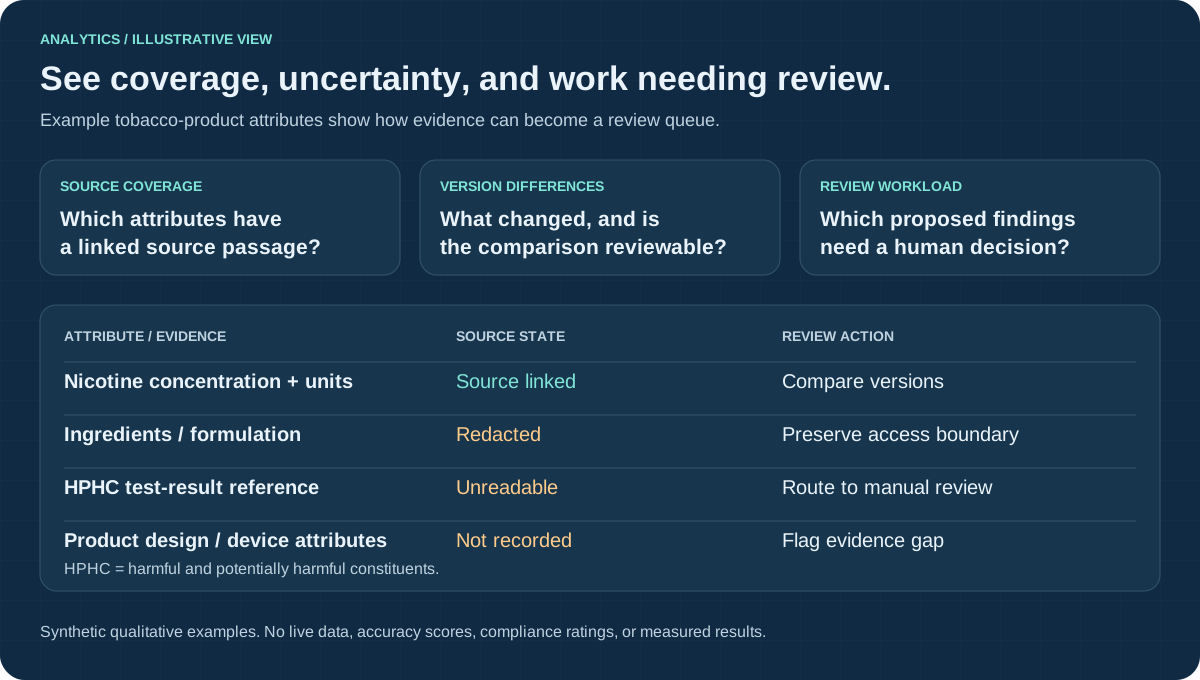
Distinguish source-linked attributes from redacted, unreadable, missing, and not-applicable values.
Compare source-backed versions before accepting a proposed change or relationship.
Route uncertain findings to reviewers and retain their decisions and reasons.
PLATO IN VIEW
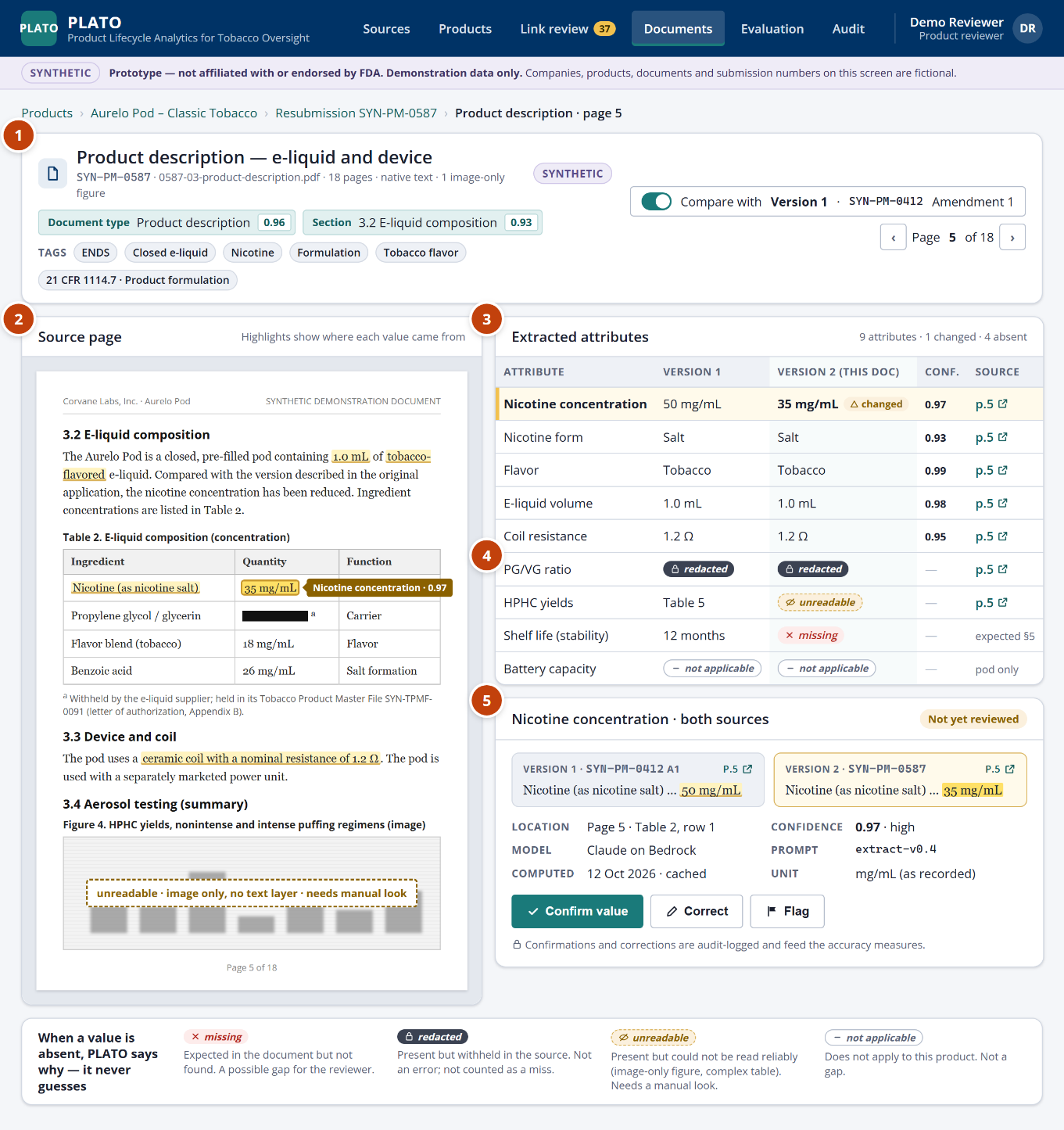
The synthetic reviewer workspace illustrates classification, highlighted source passages, version comparison, explicit absence reasons, and reviewer confirmation.
HUMAN CONTROL
Reviewers confirm, correct, reject, defer, or flag proposed outputs. Decisions and reasons form an audit trail. Missing values retain a reason such as redacted, unreadable, missing, or not applicable.
REPRESENTATIVE USE CASES
Bring related submissions, amendments, and decisions into a longitudinal view.
Compare extracted values against source passages and record corrections or absence reasons.
Inspect link rationale and version differences before accepting a proposed association or change alert.
FROM PROTOTYPE TO EVALUATED READINESS
PLATO’s evidence base consists of public FDA data profiling and a synthetic demonstration. It makes no regulatory determinations about real products and does not establish production deployment, measured accuracy, or production readiness.
Client work depends on representative samples, approved tools and workspaces, authorized access, reviewer participation, and agreed evaluation thresholds. Confidential commercial information and master file references retain their access boundaries.
Explore our Health & Regulatory Intelligence servicesSTART WITH YOUR MISSION
Define the sources, reviewer needs, and outcomes for an evaluated pilot.